
How Maslow Doesn’t Explain Why You Keep Choosing Wrong
You can climb the whole world and still choose love from the basement.

The Pyramid Breaks Down in Love
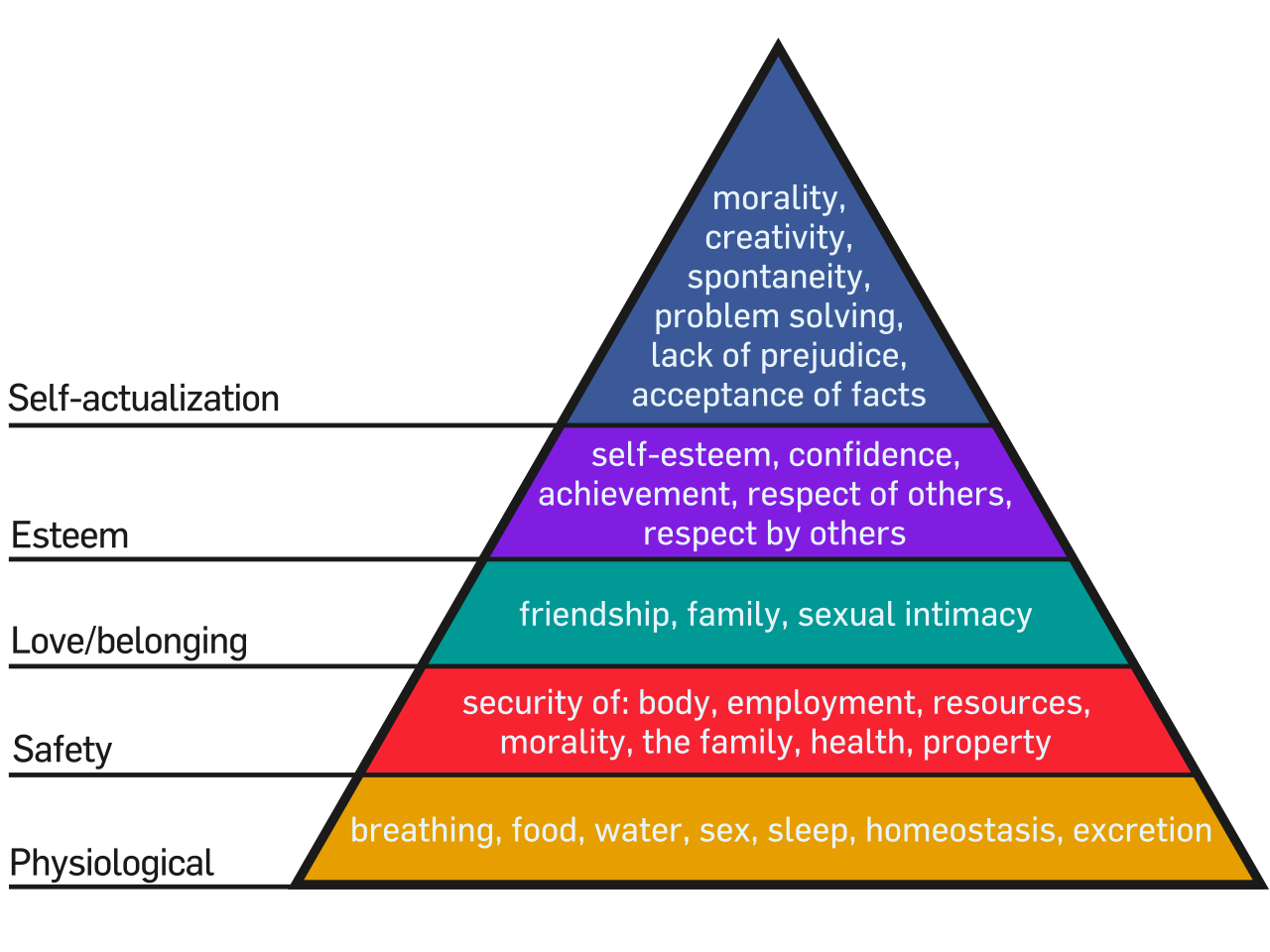
Maslow gave us a clean pyramid. Food, safety, love, esteem, meaning. A simple map for human need. Useful, elegant, easy to remember, and still painfully incomplete when someone has spent years building a life that looks developed from the outside while their love life keeps returning them to the same emotional floorboard.
There is a particular humiliation that comes for smart people in heartbreak. The pain comes with the private insult of knowing better. The mind starts running its post-mortem. Every missed red flag gets dragged into the light. Every small bodily hesitation suddenly looks obvious. Every moment of overgiving, excusing, shrinking, waiting, hoping, rescuing, explaining, spiritualising, sexualising, mothering, managing, or pretending gets entered into the court transcript of the self. By the time the relationship ends, the person may understand the pattern with exquisite detail and still feel disturbed by the fact that understanding arrived after the chooser had already done the damage.
The Smart Person’s Heartbreak
That is where Maslow fails to explain the deeper problem. The old hierarchy can describe what a human needs to grow, but it does not explain why a capable person with food, shelter, income, friends, therapy, language, self-awareness, a morning routine, and a decent public identity can still feel magnetised by someone who carries the emotional scent of an old wound.
It does not explain why a successful woman can lead a team, raise children, manage money, read the room, sense danger at work, and then lose her centre in the presence of an avoidant man who gives her just enough warmth to keep her nervous system leaning forward. It does not explain why a man can build strength, discipline, wealth, body, reputation, and purpose, then quietly become a boy again inside a relationship where affection has to be earned.
A person can appear to have climbed. Their attraction may still be organised around survival.
The Outer Life Can Climb While the Chooser Stays Young
The outer life can be polished, resourced, articulate, and admirable while the inner chooser is still loyal to the emotional conditions that formed it. This is why the phrase “I’ve done the work” can become both true and dangerous. True, because the person may have genuinely spent years reflecting, healing, learning, forgiving, regulating, processing, reading, and rebuilding. Dangerous, because the part of them that chooses in love may still be calibrated to the original ache. The mind may have moved into adulthood while the body keeps searching for the relationship weather it learned to call home.
Maslow’s pyramid places love and belonging somewhere in the middle, as though it is one developmental step among others. In real life, love does something more ruthless. It tests every layer at once. The wrong relationship can disturb sleep, appetite, money, sex, breath, self-respect, spiritual practice, parenting, work, friendship, dignity, and future vision. The right relationship, approached through an unrepaired Love Map, can still be misread by a body addicted to difficulty. This is why many people need something deeper than better standards. They need to discover what their body has been using as evidence for love.
The Love Map Behind Attraction
I call this the Love Map.
Your Love Map is the inner pattern that helps you locate intimacy. It is built through family, attachment, emotional memory, survival, longing, rejection, loyalty, shame, hope, neglect, and the strange private meanings your body gave to closeness before you had the language to question it. A Love Map tells you who feels familiar, who feels exciting, who feels safe, who feels boring, who feels like a challenge, who feels worth proving yourself to, and who your body starts bending around before your conscious mind has had a proper vote.
This is why a person can become very educated about relationships and still keep choosing wrong. Knowledge informs the mind. The Love Map directs the chooser.
When Insight Becomes Another Hiding Place
That distinction is brutal when you are heartbroken. After the ending, the smart mind tends to do what it does best. It builds a cathedral around the wound and calls it understanding. It gathers insight, creates meaning, names the trauma, diagnoses the dynamic, explains the avoidant, explains the narcissist, explains the chemistry, explains the family imprint, explains the sex, explains the betrayal, explains the collapse, explains why it was always going to end.
Some of that may be accurate. Some of it may even be necessary. The problem arrives when explanation becomes a substitute for alteration.
A person can understand the basement beautifully and still keep walking down the stairs.
The Love Map Hierarchy
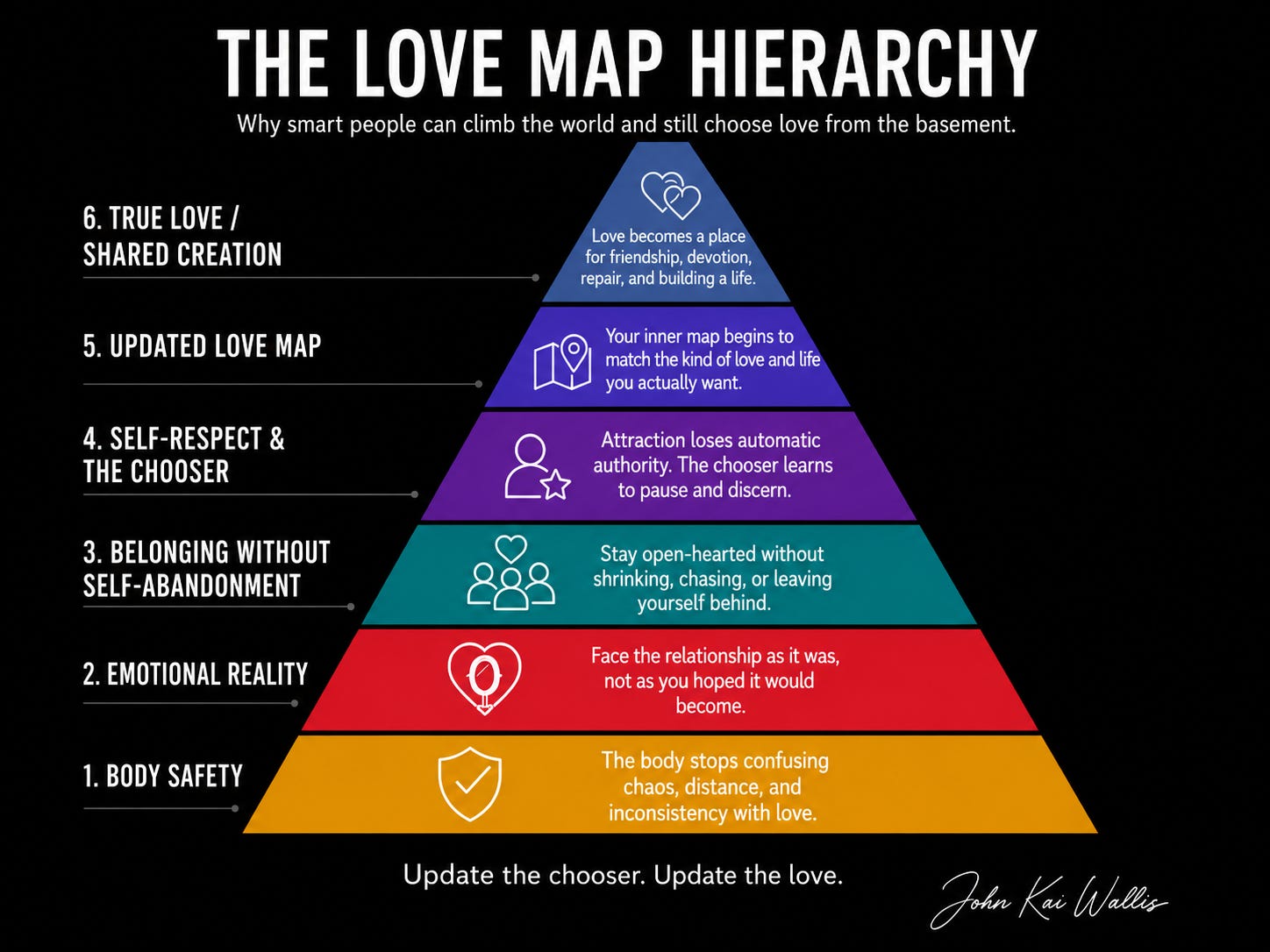
The Love Map Hierarchy is my way of looking at the pyramid underneath partner selection. It begins where attraction actually begins: in the body. Before someone can choose true love with clarity, the body has to stop treating chaos as chemistry, distance as desire, inconsistency as intimacy, and pursuit as proof of devotion. A body trained in uncertainty may feel strangely flat around a steady person. A body trained to win love may distrust love that arrives without a performance. A body trained to disappear may experience healthy closeness as exposure. None of this is solved by a clever dating checklist. The body has its own history, and until that history is brought into contact with reality, the wrong person can keep feeling correct.
1. Body Safety
This is where relationship work becomes more honest than advice. Before someone asks what they want in a partner, they may need to ask what their body has been calling safe. For some, safety has meant control. For others, distance. Some learned to feel safe only when they were needed. Some learned to feel safe when they were impressive, sexually desired, emotionally useful, low-maintenance, mysterious, agreeable, powerful, unavailable, or impossible to fully reach. These strategies can look like personality. Under pressure, they reveal themselves as survival.
2. Emotional Reality
This is where the story starts losing its glamour. The person has to face the relationship as it was, rather than the relationship they kept hoping it would become. This includes the red flags they explained away, the body signals they overruled, the needs they silenced, the loneliness they normalised, the mismatch they spiritualised, and the small humiliations they learned to tolerate in exchange for intermittent connection. Emotional reality is sobering because it removes the fantasy without shaming the longing. The point is to see clearly enough that the old spell starts to weaken.
3. Belonging Without Self-Abandonment
This is where many intelligent people discover the cost of their own adaptation. They may have called it loyalty, devotion, patience, compassion, maturity, or depth, yet the body was slowly being trained to leave itself in order to keep contact. A person can be very open-hearted and still abandon themselves. Openness without discernment can become a doorway back into the same injury. Discernment without openness can become a lonely shrine to control. The work is to belong without becoming false, to stay close without disappearing, to keep the heart available while the self remains intact.
4. Self-Respect and the Chooser
This is where attraction loses its automatic authority. Many people give chemistry a spiritual promotion it has not earned. They feel a charge and assume meaning. They feel pull and assume destiny. They feel intensity and assume depth. A recalibrated chooser can feel attraction without handing it the steering wheel. Self-respect at this level is quieter than bravado. It is the capacity to pause before the old body says yes. It is the ability to notice, with some sobriety, that the part of you that wants this person may be the same part of you that has been trying to heal an old wound through a new face.
5. Updated Love Map
This is where the work becomes creative. The person starts building a new internal reference point for love. Their attraction begins to include peace, truth, friendship, repair, reciprocity, sexual honesty, shared direction, emotional maturity, and the lived experience of being able to remain themselves. This is deeper than writing a list of partner qualities. Lists can be made by the mind while the body remains loyal to the past. An updated Love Map changes what the person recognises as love. It changes what they can receive without suspicion, what they can refuse without drama, and what they can walk away from without turning the ending into another identity wound.
6. True Love and Shared Creation
This is where love becomes more than relief from loneliness. True love asks for a life. It asks for friendship, devotion, body, truth, sex, money, family, conflict, repair, time, rhythm, play, responsibility, and a future that can hold two people without swallowing either of them. Many people say they want this. Fewer have updated the internal map required to choose it. The fantasy of true love is often easier to desire than the nervous system reality of being met by it.
Heartbreak as Sacred Interruption
This is why heartbreak can become a sacred interruption for the right person. It breaks the trance. It exposes the false map. It reveals the hidden agreement between longing and survival. It shows where the person has been trying to get love from a place that cannot give it, or trying to become desirable to someone who would require their self-abandonment as the entry fee.
The danger for smart people is that heartbreak can also become another intellectual project. The mind starts renovating the wound instead of letting the wound tell the truth. It reads another book, watches another video, creates another theory, finds another label, builds another elegant explanation, and somehow the chooser remains untouched. This is the loop that makes people feel insane. They can explain the pattern and still feel pulled toward it. They can name the wound and still date from it. They can speak beautifully about self-worth and still negotiate with someone who has already shown them the limit of what they can offer.
The Part That Chooses Has to Change
That is why I am less interested in whether someone can describe their pattern and more interested in whether the part of them that chooses has changed.
A person ready for true love does not need to become cynical. They do not need to harden, perform detachment, punish themselves for wanting love, or turn every future partner into a suspect. The open heart is still essential. The difference is that the open heart must be joined by an updated map. Otherwise love becomes another place where the body tries to complete old business with someone who resembles the wound.
Maslow gave us a pyramid of need. The Love Map shows us the hierarchy of relational readiness. Body safety. Emotional reality. Belonging without self-abandonment. Self-respect and the chooser. Updated Love Map. True love and shared creation.
That is the climb many successful people never realise they still need to make.
Update the Chooser
Your life may be developed while your chooser remains young. Your mind may be brilliant while attraction stays loyal to pain. Your heart may be ready while the map still points you toward the person who feels like home because they resemble the wound.
This is the quieter truth beneath so much heartbreak: choosing better rarely begins with finding a better person. It begins with updating the part of you that keeps making the wrong person feel like home.
If this found you in the space between heartbreak and true love, let it land slowly. There may be a part of you that already knows the next chapter cannot be built from the same map. That is a good sign. The ache is no longer only grief. It may be the beginning of discernment.
Update the chooser.
Update the love.